
UGC-VideoCaptioner: An Omni UGC Video Detail Caption Model and New Benchmarks

User-generated content (UGC) videos—like TikToks—combine fast-paced visuals, music, and speech, requiring deep multimodal understanding. Existingbenchmarks are mostly visual-only, neglecting the crucial role of audio.
To address this, researchers introduce UGC-VideoCap—a new benchmark for detailed audio-visual
captioning—and UGC-VideoCaptioner-3B, a compact model distilled from Gemini-2.5 Flash using supervised fine-tuning (SFT) and GRPO reinforcementlearning.
UGC-VideoCap Benchmark Design
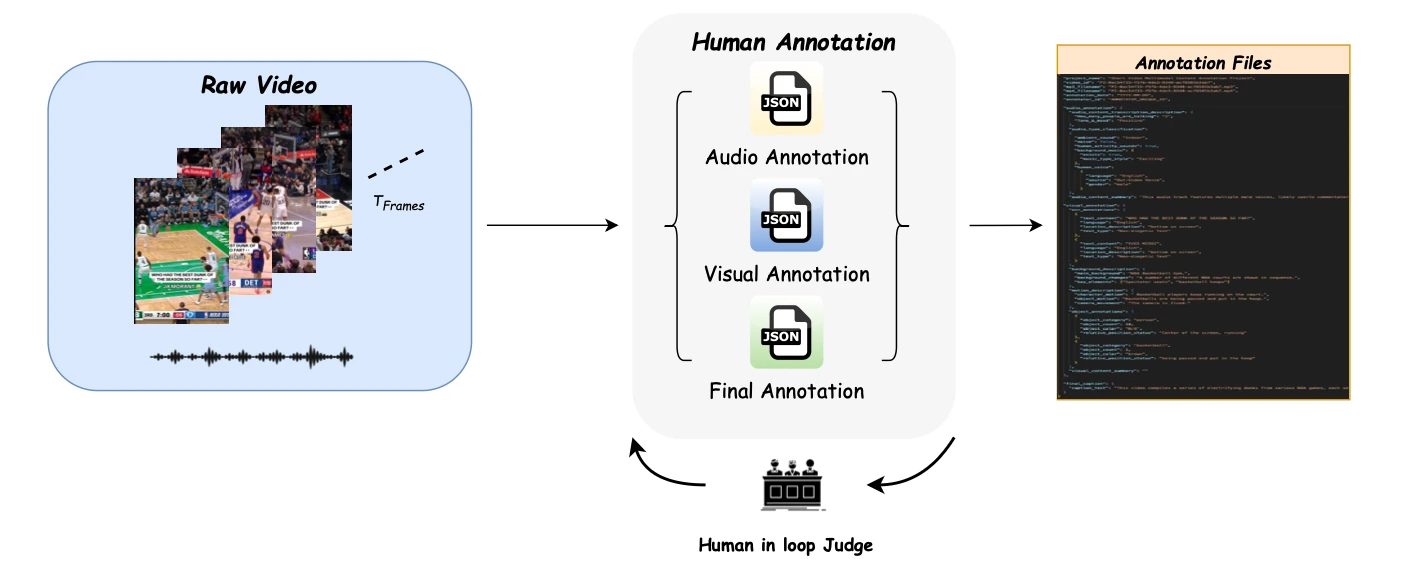
The benchmark contains 1,000 short TikTok videos annotated through three stages—audio, visual, and audio-visual captions—plus 4,000 QA pairs forunimodal and cross-modal testing. Below figure depicts the annotation pipeline integrating raw video, sound, and scene descriptions verified throughhuman-in-the-loop QA.
Evaluation and Findings
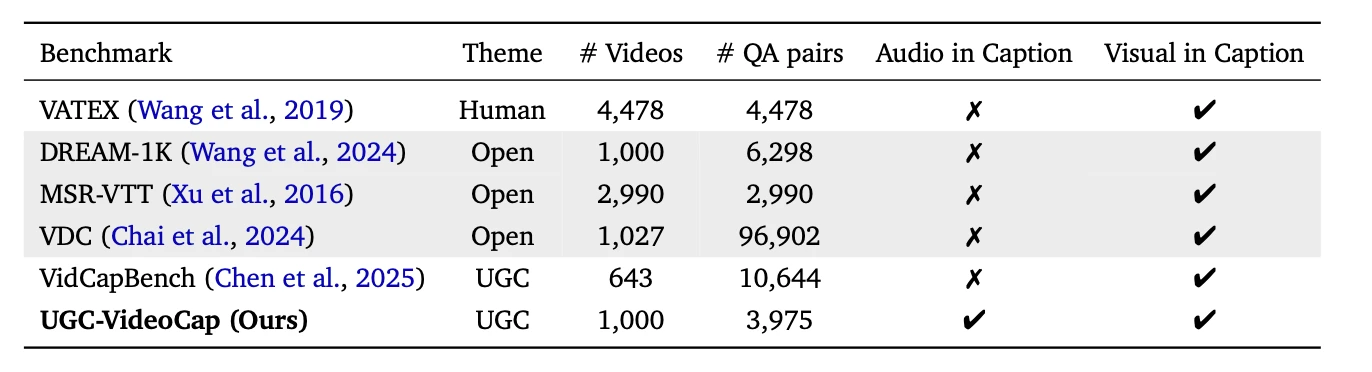
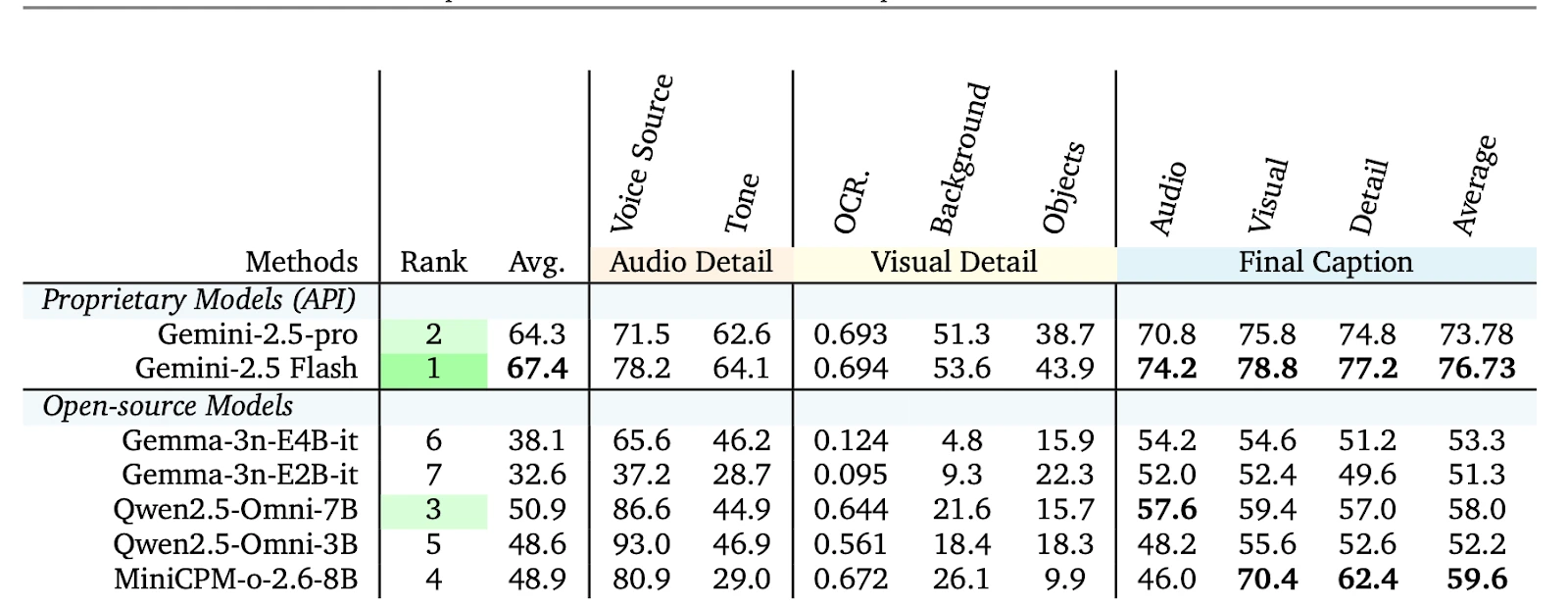
UGC-VideoCap extends beyond visual-only datasets such as MSR-VTT or VidCapBench. Table-1 outlines its multimodal coverage, while Table-2 comparesmodel performance across commercial and open models.
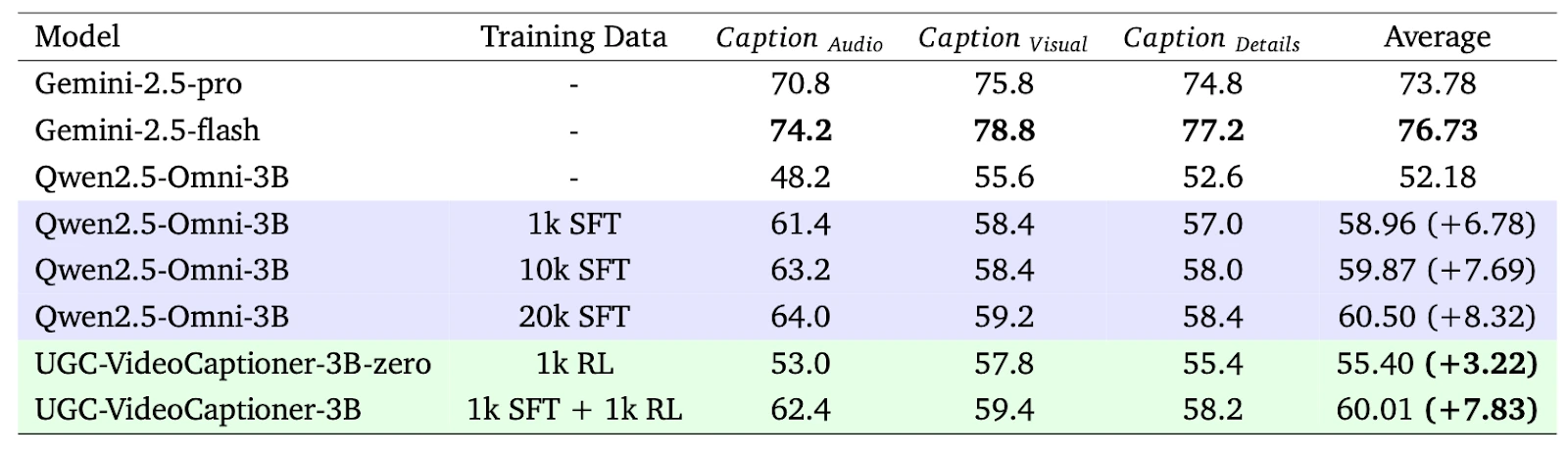
- Gemini-2.5 Flash: Highest overall score (76.73%), excelling at detailed multimodal reasoning.- Gemini-2.5 Pro: Achieves 73.78%, slightly weaker on OCR and sound event interpretation.- Open-source Models: Qwen2.5-Omni and MiniCPM-o-2.6 trail behind, showing fragmented multimodal integration.- Key Insight: Most models still process audio and visuals separately, limiting cohesive understanding.
The UGC-VideoCaptioner Model
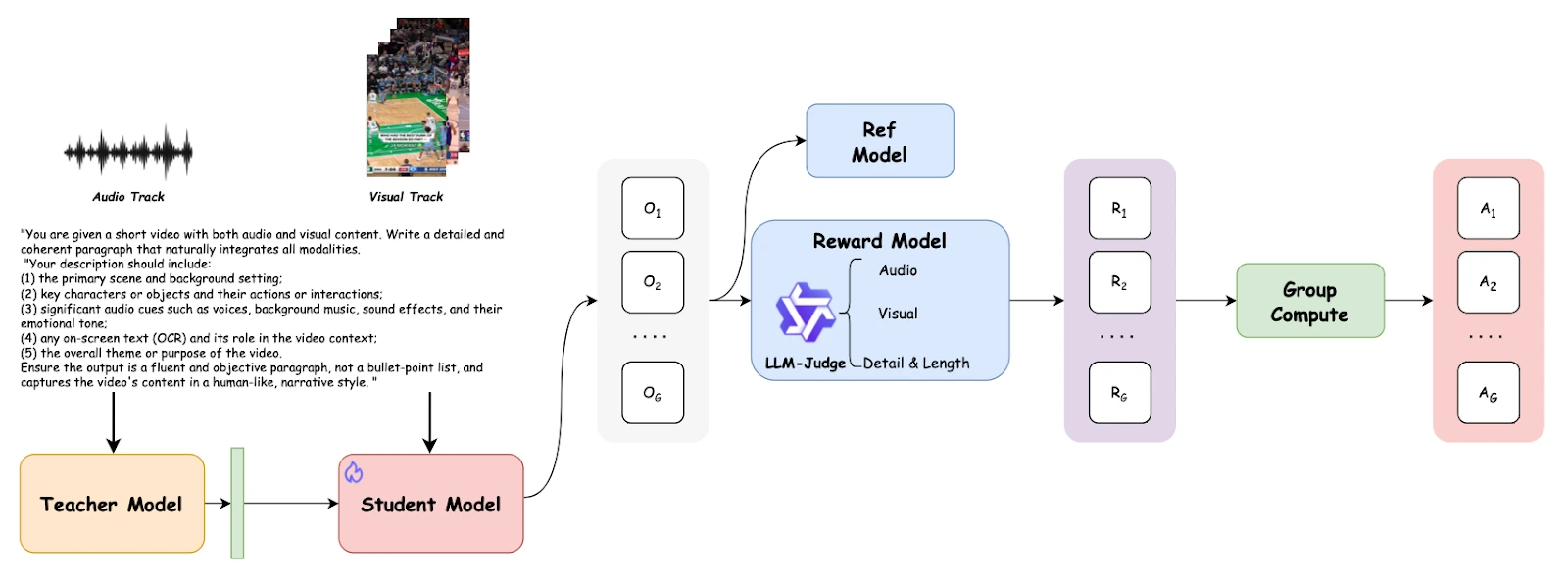
UGC-VideoCaptioner-3B is trained via two stages as shown in the figure below:
- Stage 1 – Distillation: Gemini-2.5 Flash auto-labels 20k TikTok clips, transferring knowledge to Qwen2.5-Omni-3B.- Stage 2 – Reinforcement Learning: GRPO fine-tunes caption fluency and factual precision usingLLM-based scoring. Instead of relying on critics, GRPO ranks multiple generated captions per sample and rewards human-like coherence and audio-visual consistency as depicted below.
Quantitative Results
Table-3 reports the main outcomes. The 1k SFT + 1k RL setup improves performance by +7.83 points, approaching the 20k SFT model’s accuracy. GRPOenhances caption richness and reduces hallucinations, achieving a 60.01 average score—close to Gemini-2.5 Flash’s 76.73 benchmark.
Key Insights
- Audio is essential: Ignoring sound cues causes up to a 25-point accuracy loss.
- Efficient small-data training: With just 2k samples, distillation can rival large-scale training.
- Human-in-the-loop QA: Ensures reliable, semantically rich multimodal annotations.
Conclusion
UGC-VideoCaptioner and the UGC-VideoCap benchmark redefine multimodal video captioning by merging detailed sound, text, and visual understanding. Through Gemini-guided distillation and GRPO training, UGC-VideoCaptioner delivers rich, human-like captions efficiently. This work marks a significant advance toward AI systems that can both see and hear the fast-evolving world of UGC content.